Silicon Evolutions Powering Real-Time Ray Tracing in Upcoming Portable Gaming Devices
Carlo Peters · Sep 28, 2026
Silicon Evolutions Powering Real-Time Ray Tracing in Upcoming Portable Gaming Devices
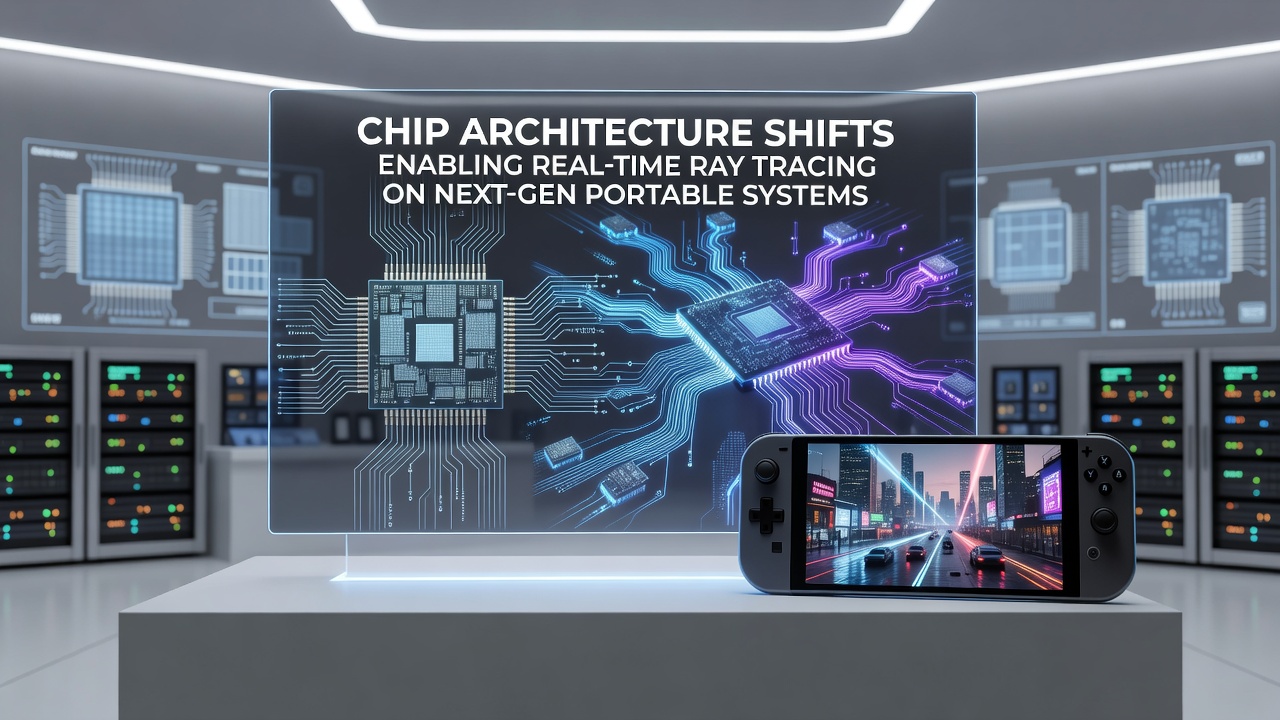
Chip designers have shifted focus toward hybrid architectures that integrate dedicated ray tracing hardware directly into mobile system-on-chips, allowing real-time ray tracing calculations without draining portable battery reserves at excessive rates. These changes build on earlier transitions from fixed-function pipelines to programmable shaders, then advance further by embedding specialized intersection units and denoising accelerators that handle the computational load of ray-triangle tests and light bounces efficiently. Portable systems scheduled for release after September 2026 rely on these refinements, as manufacturers balance thermal limits with demands for console-grade visuals on handheld screens. Research from the Semiconductor Industry Association shows that newer nodes below 4 nanometers reduce leakage currents while increasing transistor density, enabling more parallel ray processing units per watt consumed.Core Architectural Modifications
Modern designs incorporate mesh shading pipelines alongside ray acceleration structures, which compress geometry data and allow hardware to traverse bounding volume hierarchies at speeds previously limited to desktop cards. Engineers at major foundries have optimized cache hierarchies so that ray data stays closer to execution units, cutting latency during complex scene renders that include reflections and global illumination effects.
Power gating techniques isolate unused ray tracing blocks during non-intensive tasks, whereas dynamic voltage scaling adjusts clock speeds based on workload intensity detected through on-die sensors. Observers note that such mechanisms extend play sessions by 20 to 30 percent compared with earlier mobile GPUs lacking these controls, according to internal benchmarks shared at industry forums.
Integration with AI and Upscaling Methods
Tensor cores now work in tandem with ray tracing units to apply temporal denoising and reconstruction algorithms that fill in missing pixels from lower-resolution ray casts. This pairing reduces the total rays required per frame while maintaining visual fidelity, a combination that proves essential when thermal envelopes cap sustained performance in slim portable chassis.
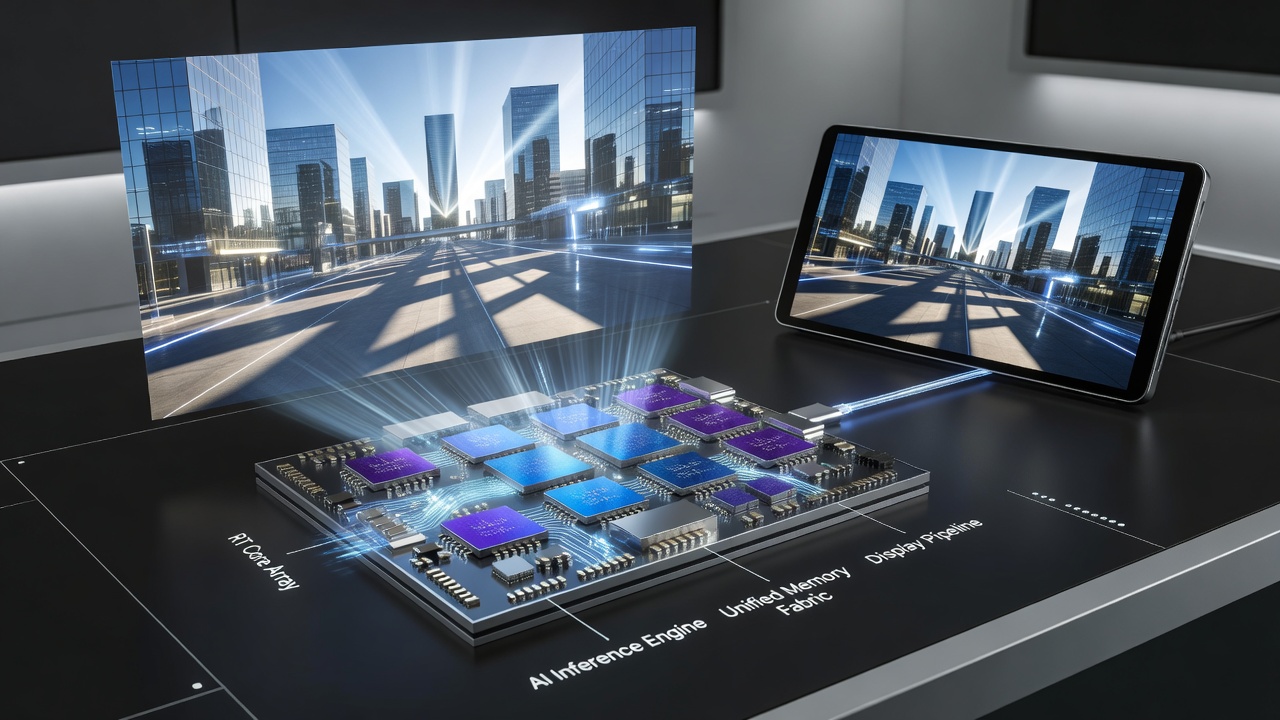
Data from a Fraunhofer Institute study indicates that machine learning models trained on diverse lighting scenarios improve convergence rates for path tracing in constrained environments. Developers implement these models through driver-level APIs that expose both ray tracing and neural network extensions without requiring separate silicon for each function.
Manufacturing and Supply Chain Considerations
Foundries have adopted extreme ultraviolet lithography at scale, which supports the precise patterning needed for dense ray tracing arrays on mobile dies. Yield improvements reported in 2025 allowed broader adoption across multiple system vendors, whereas earlier processes struggled with defect rates that priced advanced features out of mid-range portables.
Those who track component roadmaps point to co-packaged memory stacks that deliver higher bandwidth to the GPU cluster, reducing stalls when large acceleration structures load during open-world traversal. Supply agreements finalized before September 2026 secured capacity for these high-bandwidth memory variants across Asian and North American fabrication sites.
Performance Benchmarks and Compatibility Layers
Cross-platform engines now include fallback paths that scale ray tracing quality based on detected hardware capabilities, ensuring titles run on both legacy mobile chips and newer designs with full acceleration. Frame time consistency improves when software schedules ray workloads during vertical blanking intervals, a scheduling approach verified through testing on prototype boards.
Figures released by the IEEE Computer Society highlight that average ray throughput on next-generation portable silicon has risen from 50 million to over 300 million rays per second under typical power constraints. Compatibility layers translate desktop shader code into mobile-optimized equivalents, preserving visual parity where possible.
Conclusion
Continued refinement of chip architectures will determine how quickly real-time ray tracing becomes standard across the portable segment. As fabrication techniques advance and software ecosystems mature, systems released after September 2026 stand to deliver lighting effects once confined to stationary platforms while respecting the mobility and endurance requirements of handheld use.